

I drove trucks cross-country for eleven years, and the one piece of bedroom gear that finally fixed my overheating problem at home was a LUCID cooling gel mattress topper. Hot sleepers do not get sympathy in a Peterbilt sleeper cab in July in Texas. You learn fast or you lie awake sweating through a 10-hour reset. I tried every trick that made the rounds at truck stops: frozen water bottles, battery-powered fans, sleeping on top of the covers, cracking the AC until the cab sounded like a wind tunnel. Nothing stuck until I started putting a gel foam topper between me and whatever mattress I was dealing with. That was seven years ago. I have been a cooling-topper evangelist ever since, and this guide is everything I know about making one work the right way.
Overheating at night is not just about being uncomfortable. It cuts deep sleep, triggers early wake-ups, and leaves you feeling worse than if you had stayed up. If your mattress is trapping heat, and most mattresses do because dense foam and innerspring coils hold warmth like a storage heater, no amount of ceiling fans or thermostat tweaks will fix the root problem. A cooling mattress topper changes the surface your body is actually touching. Follow these steps and you will feel a difference on the first night.
Your mattress is a heat trap. This topper is the fix that costs less than a hotel night.
The LUCID 3-inch cooling gel topper is the one I recommend to every hot sleeper starting out. Over 103,000 Amazon buyers, 4.4 stars, and a price that will not make you hesitate. Check today's price before you read another word.
Amazon Check Today's Price on Amazon →Step 1: Diagnose Why You Are Actually Overheating
Before you spend a dollar, figure out which layer of your sleep setup is the problem. Press your hand flat against your bare mattress for thirty seconds. If it feels warm when you pull your hand away, your mattress is retaining body heat and a topper is the right fix. If your mattress surface feels cool but you still wake up sweating, the problem might be your bedding, your partner's body heat, or your room temperature rather than the mattress itself.
Memory foam mattresses, pillow-tops with dense polyfoam layers, and older innerspring models with a thick comfort layer on top are the biggest culprits. Gel foam toppers work by doing two things: first, the open-cell foam structure lets air circulate instead of pooling against your skin; second, the gel beads absorb body heat and dissipate it away from the sleep surface. That combination cools the 1-to-2-inch zone directly around your body, which is the zone that matters for your core temperature at night.
If your room temperature is above 72 degrees Fahrenheit at bedtime, address that first. A cooling topper does real work, but it cannot fight a room that is 80 degrees. Get the room down, then let the topper handle the residual mattress heat. In truck cabs with no great climate control, I used a 12-volt fan pointed at the bunk and the topper together. That combination worked in July. In a house bedroom with a window unit or central air, you have it easier.
Step 2: Pick the Right Thickness for Your Body and Mattress
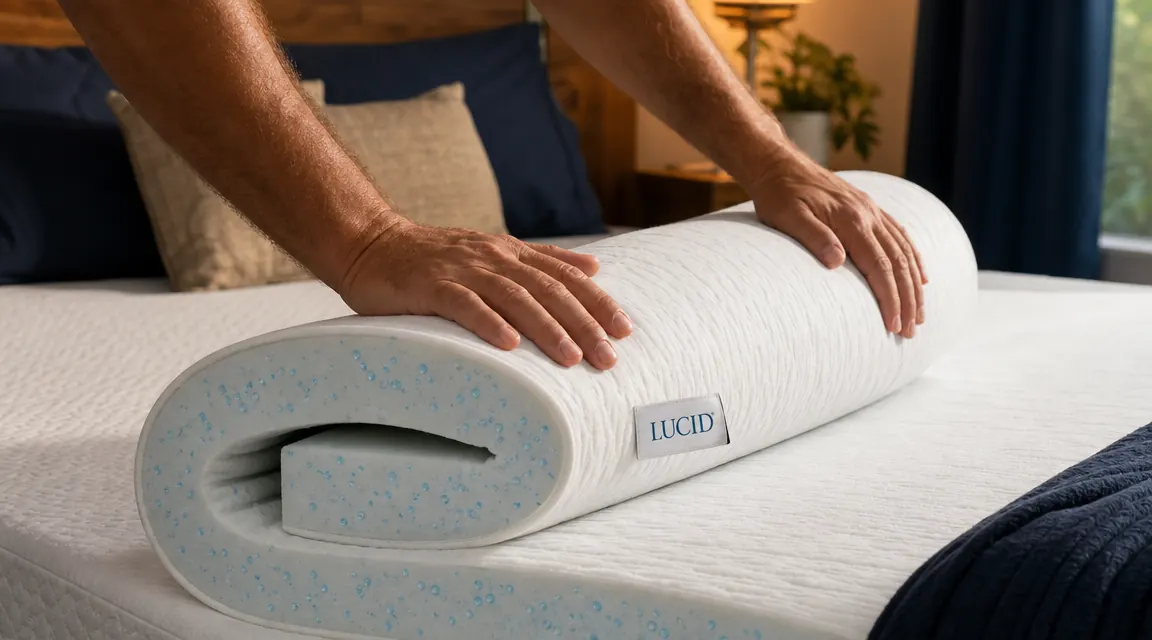
Cooling topper thickness is not just about comfort. It directly affects how much heat regulation you get and how much the feel of your existing mattress changes. The standard options are 2-inch, 3-inch, and 4-inch. Here is how I think about it: if you weigh under 150 pounds or sleep on your side, a 2-inch topper adds noticeable softness without changing the support profile much. If you weigh 150 to 220 pounds or sleep on your back, a 3-inch is the sweet spot. If you weigh over 220 pounds or your mattress is genuinely firm, go to 4 inches.
I am 215 pounds and spent most of my time on my back in the bunk, so the 3-inch LUCID gel topper was the right call for me. It gave enough foam depth to actually encase my hips and shoulders, which is where I radiate the most heat. Thinner toppers sit more on top of your body; thicker ones let your body sink in slightly, which surrounds more skin surface with the cooling gel layer. More surface contact with cooling material equals faster heat transfer away from your body.
One thing most people get wrong: they assume a thicker topper will sleep hotter because there is more foam. The opposite is true with open-cell gel foam. A 2-inch slab of dense traditional memory foam sleeps hotter than a 3-inch open-cell gel slab because the density matters more than the thickness. Look for toppers labeled open-cell construction or ventilated channels if you are comparing brands.
Step 3: Set Up the Topper Correctly on the First Night
Gel foam toppers ship compressed and vacuum-sealed. When you cut the plastic wrap, the foam needs 24 to 72 hours to fully expand. Do not put a sheet over it and sleep on it the same night you unbox it. The foam is still off-gassing from the packaging process and it has not reached full loft. Unbox it, lay it flat on the mattress, and let it breathe for at least one full day before you sleep on it. I did this wrong the first time, wondering why the edges were not fully expanded, and by night three I had a full-loft topper and better results.
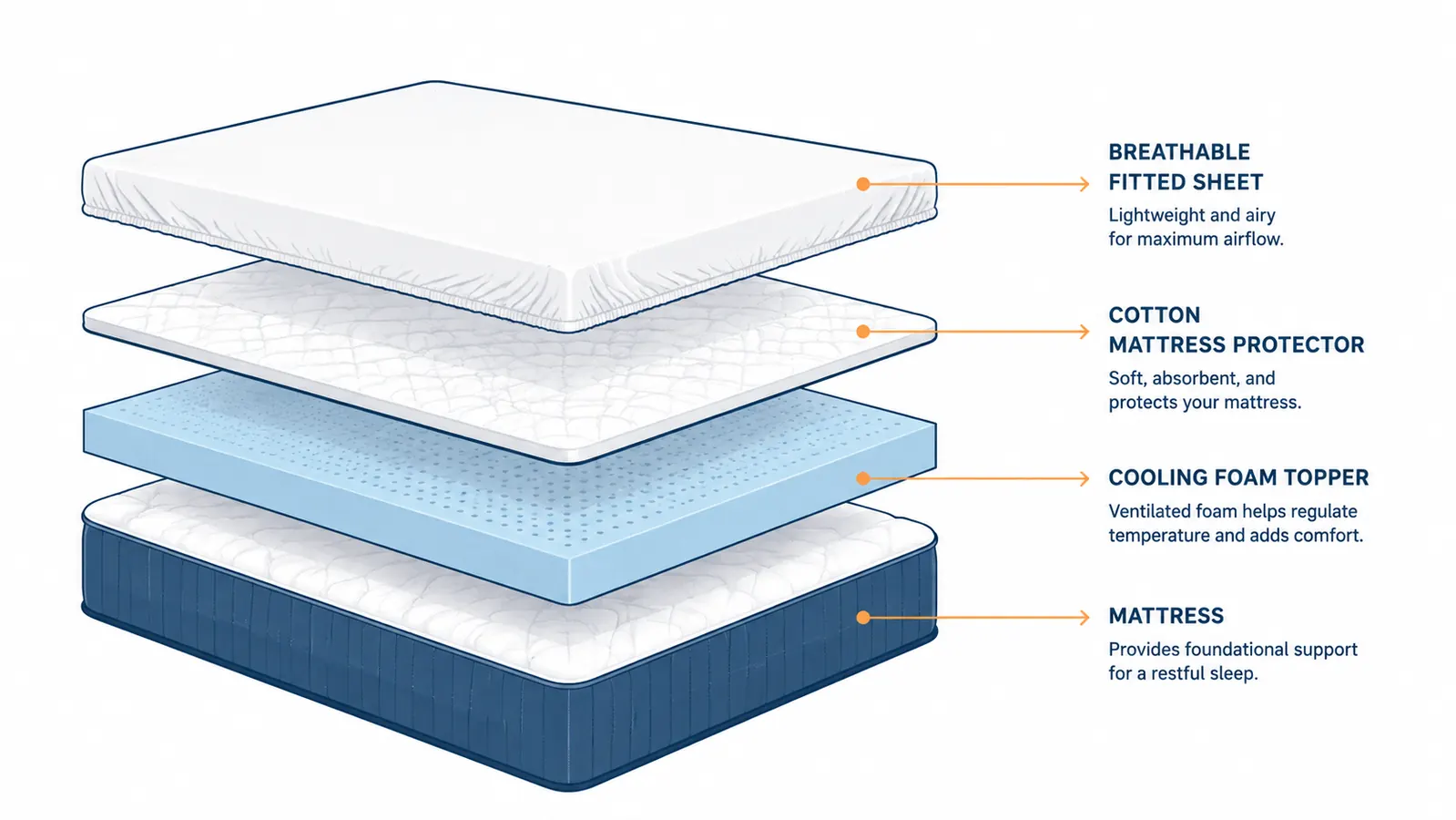
Once it has expanded, get the layering order right. The topper goes directly on the mattress. Then comes your mattress protector if you use one. Then your fitted sheet goes over both. That order keeps the topper stable and keeps it from bunching under the sheet. If you put the mattress protector under the topper, you create a slippery surface that lets the topper slide when you move, and you will be tucking it back in every morning.
The topper goes on the mattress first. Protector second. Sheet last. Get that order wrong and you are fighting bunching every single night.
Use a fitted sheet with deep pockets, at least 15 inches of drop, to accommodate the added height. A standard 12-inch fitted sheet will pop off the corner by 3am and you will wake up on bare foam. Buy one set of deep-pocket sheets when you buy the topper. Do not skip this step.

Step 4: Choose the Right Bedding to Work With the Topper, Not Against It
A cooling gel topper cannot do its job if you pile a thick polyester comforter on top of it. The topper cools from below. Your bedding controls the environment from above. If your top layer traps heat, you will still wake up sweating even on the best cooling topper made. This step is free, which is why I want you to pay attention to it.
Swap to a cotton percale or bamboo-viscose fitted sheet first. Those fabrics breathe and wick moisture rather than holding it against your skin. For your top layer, use a cotton or tencel blanket instead of a synthetic comforter. If you live somewhere that gets cold at night and need a real comforter, look for ones with a down alternative fill and a 300-thread-count cotton shell. Avoid polyester shell comforters entirely if you run hot.
I slept better in a Comfort Inn in Flagstaff in February than I did at home in Florida in October, and the difference was not the gel topper. It was that the motel had thin cotton blankets I could stack or remove instead of one heavy polyester comforter that could not be regulated. Layering thin, breathable bedding lets you self-regulate through the night without fully waking up. The topper handles the mattress heat. Light, natural-fiber bedding handles the ambient heat around your body.
Step 5: Pair the Topper With a Room Cooling Strategy for the First Two Weeks
The first two weeks on a new cooling topper are when your body is calibrating. The foam is also finishing its break-in period, softening slightly to your body shape and sleeping position. During this window, give the system the best possible conditions: keep your bedroom between 65 and 68 degrees Fahrenheit before bed, use a fan to circulate air across the bed surface if possible, and avoid eating heavy meals or drinking alcohol within two hours of bedtime since both raise core body temperature for hours.
A box fan set to low on the floor pointed at the bed works better than a ceiling fan for direct air movement across the sleep surface. Ceiling fans push air down onto your body from above. A floor fan at the foot of the bed pulls cooler air across the topper from the floor level up. That direction of airflow assists the heat dissipation the topper is already doing. You are running hot air away from the surface instead of just stirring it around the room.
After two weeks, most people find they need less supplemental cooling because their body temperature has stabilized, the foam has fully shaped to them, and they have gotten the layering right. At that point, the topper is doing most of the work passively and you can dial back the fan or raise the thermostat a degree or two without feeling it.
What Else Helps
A cooling topper does the heavy lifting but three other things are worth knowing about. First, a cooling pillow cover. Your face and scalp generate a lot of heat and your pillow holds it close to your head. A bamboo or cooling-gel pillow cover runs about twelve dollars and makes a noticeable difference, especially if you are a face-down or side sleeper. Second, moisture-wicking sleep clothes or sleeping without clothes entirely. Fabric between your skin and the topper slows heat transfer. If you are in a private bedroom, try sleeping without the extra insulation layer one night and see how you feel.
Third, magnesium glycinate. I know this sounds like a supplement pitch. Stay with me. Magnesium helps your muscles relax before sleep, which reduces the low-level muscular tension that generates body heat at night. A lot of hot sleepers run magnesium-deficient without knowing it. Taking 200mg about an hour before bed does not knock you out, but it does lower the baseline heat your muscles produce overnight. I have been doing this for four years and it is the quietest thing in my sleep stack. You can read more about how magnesium fits into a sleep routine in our guide to the LUCID gel topper long-term review.
One thing I would skip: those cooling mattress pad toppers with water circulation systems. They work, but they cost three to five hundred dollars, require a bedside unit you have to fill and clean, and if the pump fails at 2am you are waking up to fix it. For most hot sleepers, a quality gel foam topper at a fraction of the price solves 90 percent of the problem without the maintenance headache. If you are a clinical-level heat radiator or a menopausal hot-flash situation, the water-circulation units might be worth the price. For everyone else, start simpler.
Your pillow traps almost as much heat as your mattress. A bamboo pillow cover and a gel topper together are a better investment than a cooling mattress alone.
If you want to go deeper on why cooling toppers work and what to expect over months of use, check out the full year-of-use breakdown in our LUCID mattress topper long-term review. And if you are still not sure whether a topper is the right fix or whether you just need better night-sweat management overall, the roundup of ten ways a cooling topper stops night sweats covers a lot of the use-case questions I get from readers.
You have the steps. The topper is the part you actually have to buy.
The LUCID 3-inch cooling gel topper is what I point every overheating reader toward first. It is the starting point that eliminates the mattress heat problem without spending heavily on a system you have to maintain. Over 103,000 reviewers, ships in two days, and you will know if it works by the end of week one.
Amazon Check Today's Price on Amazon →