
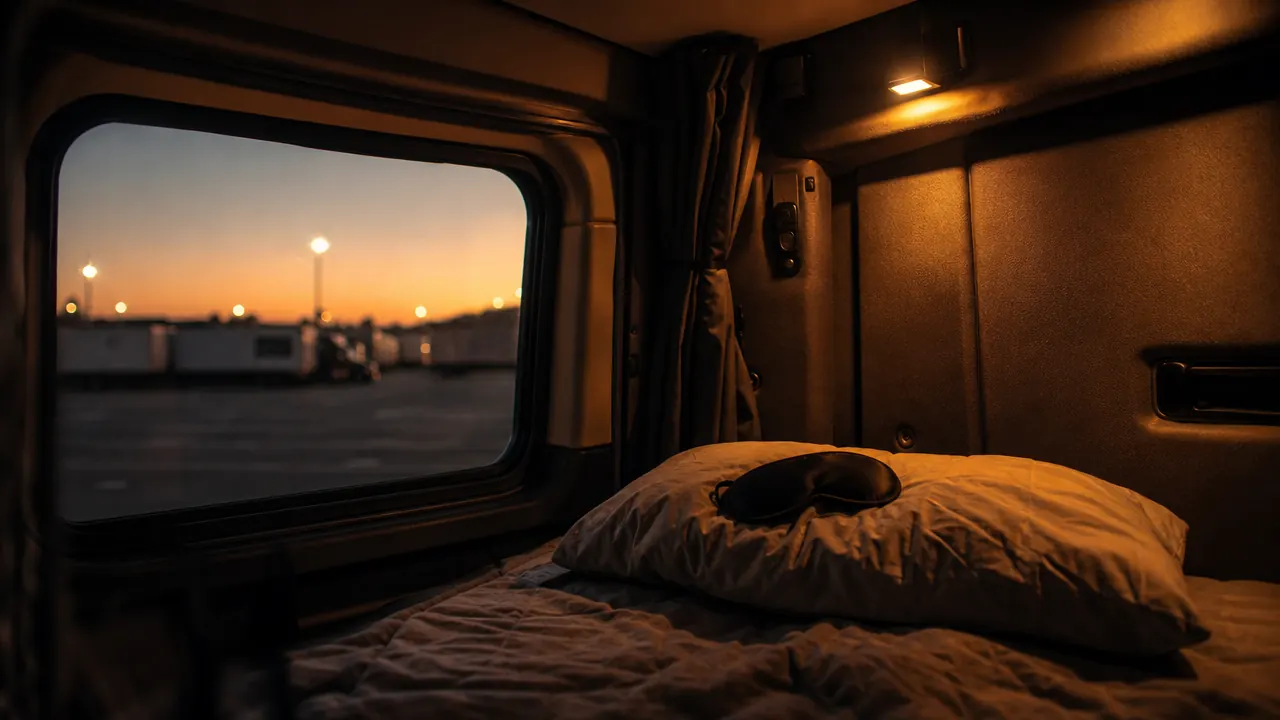
I have been driving long haul for nineteen years. Chicago to Los Angeles, Memphis to Seattle, sometimes back-to-back with a ten-hour reset in between. The thing nobody tells you before you start is that sleeping in a truck cab is one of the hardest physical skills in the job. Parking lots are lit up like ballparks at 2pm. Other drivers idle next to you. The sleeper curtain cuts some light but not close to enough. I have tried foam plugs, eye pillows, foil tape on the skylight, and every cheap flat mask from a truck stop wire rack. Most of them are useless in direct sun. The MyHalos 3D blackout sleep mask is the one that finally pulled its weight, and I have been using it every day since January, so I know exactly what it does well and where it lets you down.
Six months in, I am still on the same mask. I have also tested it at home, where my bedroom window faces southeast and the summer sun hits it hard by 6am. Between the cab and the bedroom I have put this thing through maybe 180 nights of use. That is enough time to have an honest opinion.
The Quick Verdict
The best total-blackout mask at the budget end if you can dial in the nose-bridge fit. Holds up to daily use, stays comfortable for 6-hour stretches, but wide-face sleepers may need to adjust expectations.
Amazon Check Today's Price →If afternoon light is killing your sleep, this is the cheapest fix that actually works.
The MyHalos 3D mask blocks more light than flat masks costing three times as much. Check the current price before it moves.
Amazon Check Today's Price on Amazon →How I've Used It
My primary test environment is the Peterbilt 389 sleeper cab I run out of Nashville. The bunk sits directly behind the cab, separated by a privacy curtain that does almost nothing against midday parking-lot lights. I park at Flying J and Pilot truckstops where the canopy lights are on all night, and in California I sometimes park along highway aprons that face west, which means the sunset comes straight through the curtain seam. That is a brutal environment for any sleep mask.
At home in Cookeville, Tennessee, my bedroom window is south-facing with standard blinds. In summer, sunrise light starts bleeding through around 5:45am, which on my days off cuts my sleep short by 90 minutes or more. My wife does not like blackout curtains because they make the room feel like a cave, so a personal mask is my only option. The MyHalos gets used there every morning I sleep past sunrise.
I wear it for between 5 and 7 hours at a stretch in the cab, and usually 90 to 120 minutes at home. I have run it through the washing machine four times, hand-washed it twice, and worn it sweating in a warm cab without AC. The elastic has not gone slack. The foam nose piece is still intact. The shell has not warped.
The 3D Cup Design: Why It Actually Matters
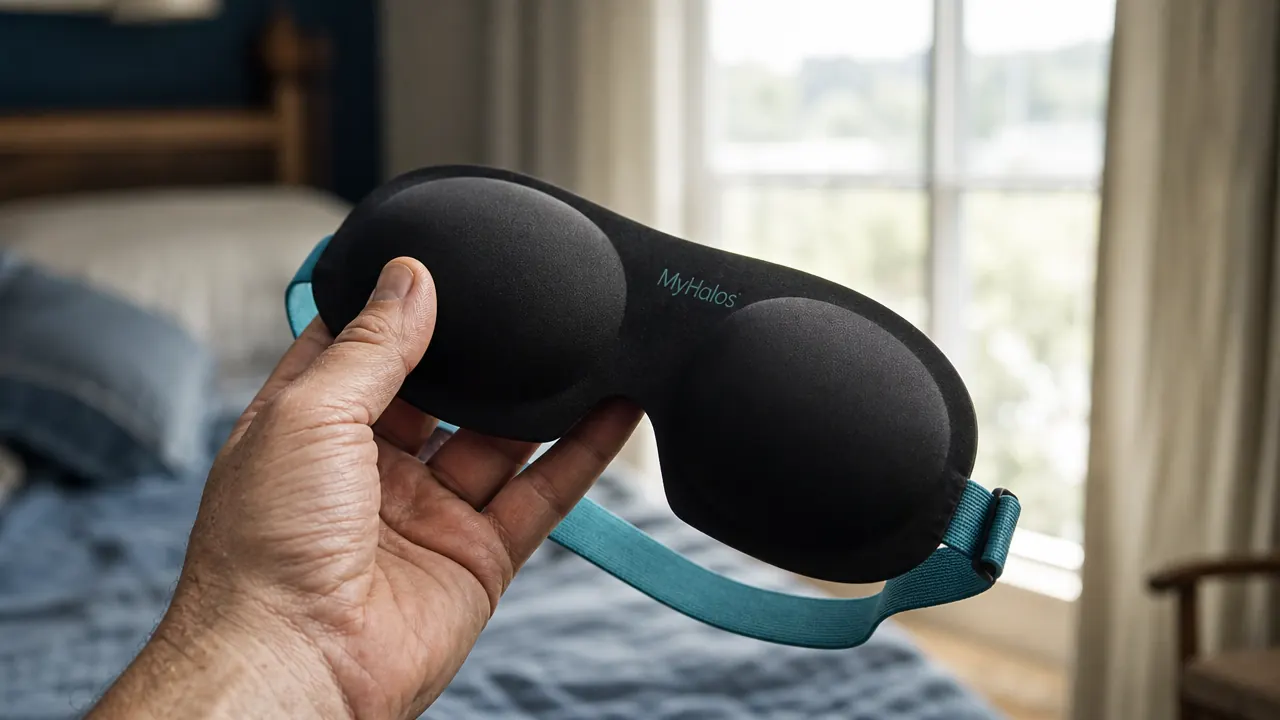
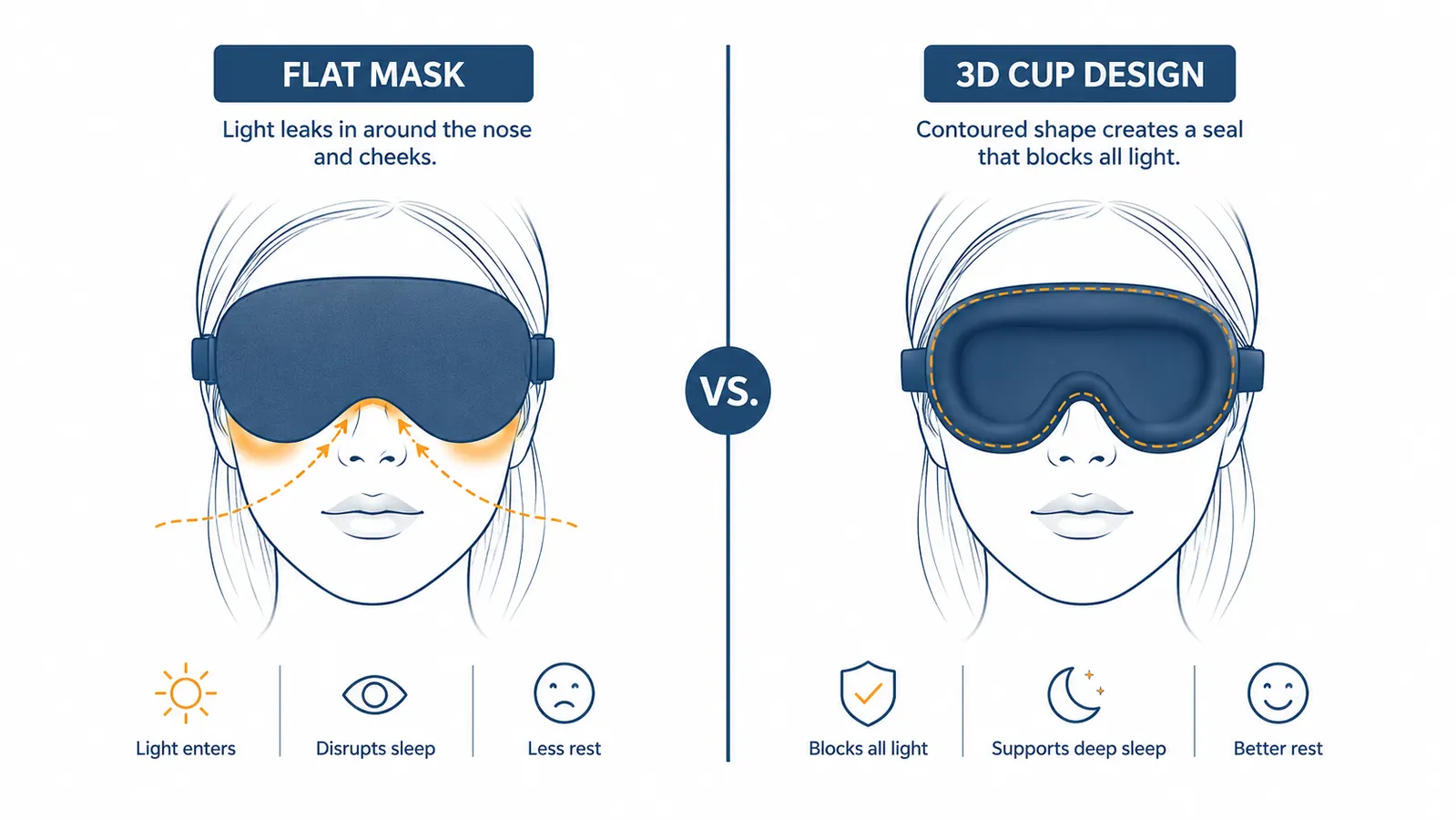
The biggest difference between the MyHalos and the flat sleep masks I wasted money on before is the raised dome design over each eye. Those domes sit above your eyelids, which does two things. First, nothing touches your eyelashes or puts pressure on your eyeballs, which matters a lot if you are a light sleeper who gets pulled awake by physical sensation. Second, the cups create a pocket of enclosed darkness that a flat mask cannot match because a flat mask just gets pushed forward by your nose bridge and lets light in underneath.
The contoured frame also gives you room to blink naturally. I know that sounds like a strange thing to care about, but when you are lying in a cab that is 90 degrees in July, your eyes move under the mask and if the fabric is dragging on your lashes every time that happens, you wake up. I stopped waking up from that the first week I switched to the MyHalos.
The shell material is a stiff lightweight plastic that holds its shape under pressure. When you press it against your face, it does not cave in on your eyes the way soft-foam masks do. The inside lining is a short plush velvet that stays soft wash after wash. After six months it has pilled a little in the center of the right cup, which is a small cosmetic issue and has not affected comfort.
Light Block: How Complete Is It Really?
I tested the light seal three ways. First, I wore it in direct midday sun in a parking lot and turned my face toward the sky. A flat mask in that test lets in a crescent of light at the nose bridge. The MyHalos blocked it fully, no visible glow, no hot spot at the nose cutout. Second, I wore it in my bedroom at 6:15am with my face pointed at the window. Same result, complete black. Third, I wore it facing our kitchen light after my wife turned it on at full brightness while I was lying on the couch. No light intrusion at all.
The caveat is fit. The nose bridge piece is a soft silicone wing that folds down against your upper nose. On my face, which runs on the narrower side, it seals clean. My buddy Dale, who has a broader nose bridge, tried the same mask and got a thin arc of light along his left cheek. If your face is wider than average or your nose bridge sits high, you may need to experiment with the strap tension to get the nose wing to seat properly. It took Dale about two minutes of adjusting to get a full seal, so it is solvable, but it is not automatic.
The first night I got a full 6-hour stretch in the cab without waking up from light, I thought something was wrong with me. Turns out nothing was wrong. I had just finally blocked out the light.
Strap Comfort Over a Long Haul
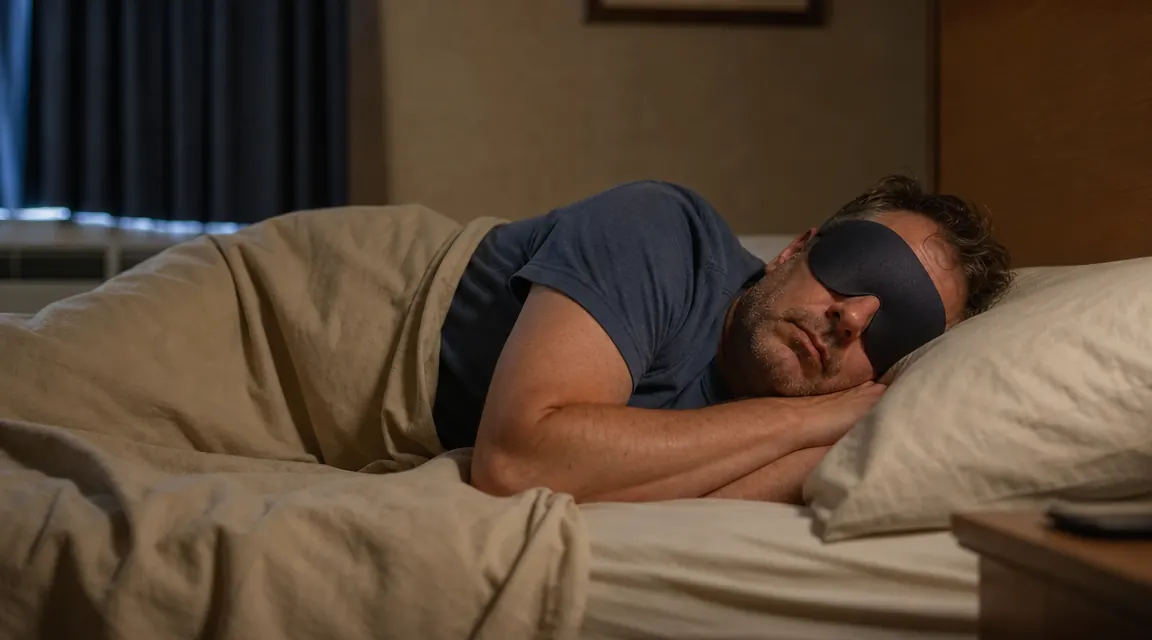
The strap is a single wide elastic band that goes over the crown of your head instead of around the back like most masks. That matters for two reasons. If you sleep on your side, a strap around your head gets pinched between your skull and the pillow and creates a pressure point that wakes you up around hour three. The over-the-crown design avoids that entirely. I am primarily a side sleeper in the cab and the strap has never woken me up.
The elastic tension is firm enough to hold the mask against your face when you roll over but not so tight that you get a headache. I have worn it for a continuous 7-hour stretch on one occasion, which was longer than planned because I was parked in Barstow and it was 108 degrees outside and I was not in a hurry to be awake. No headache when I took it off. No red pressure marks on my forehead, which I used to get from the single-strap masks I used before.
There is an adjustable buckle on the strap. After six months the buckle still clicks and holds. I have not had it slip open mid-sleep. The strap itself has not stretched out noticeably, though I will say the elastic was noticeably springier at month one than it is now. It is not loose, but it is not as crisp as new. That is normal wear for any elastic, and at this price point it is completely acceptable.
Durability After 180 Nights
Most cheap sleep masks start falling apart around the 60-day mark. The strap frays, the nose bridge foam compresses and does not spring back, or the plastic shell develops a crack at one of the molded seams. I have seen all three happen to masks I bought at truck stops.
At six months, the MyHalos shell has no cracks. The nose silicone wing is still intact, still flexible. The velvet lining has pilled slightly on one dome interior but is not rough or uncomfortable. The strap buckle works. The elastic has lost maybe five percent of its original tension, which has not affected the fit or the light seal. By any honest measure, this mask has outlasted every other mask I have tried at this price.
I machine-washed it in a mesh laundry bag on gentle cycle, cold water. The packaging says hand wash, and I ignored that, and nothing bad happened. Tumble dry low also did not warp the shell. Your results may differ, and if the mask is your main sleep tool I would follow the hand-wash instruction just to be safe. But it is good to know it survived the machine.
What I Would Change
The nose bridge fit is the biggest issue, and it is not a dealbreaker but it is real. People with wider faces or higher nose bridges will need to fiddle with the strap to get a full seal. A slightly wider nose wing would solve this for most people.
In hot weather the inside of the cups gets warm. There is no ventilation in the dome, which is by design since ventilation would let light in, but in a hot sleeper cab in July your eyes sit in a small warm pocket. I have adapted to it, and it has never woken me up, but if you run hot and are sensitive to heat buildup around your face you might find it uncomfortable in summer.
The carrying pouch that comes with it is a simple drawstring bag that tears at the seam easily. I stopped using the pouch around week three and just tuck the mask under my pillow. Not a deal breaker, but it is the weakest part of the package.
What I Liked
- 3D cup design creates complete darkness without pressing on eyelids or lashes
- Over-the-crown strap is far more comfortable for side sleepers than rear straps
- Held up through 180 nights of daily use with minimal wear
- Full light seal in direct midday sun once the nose wing is dialed in
- Machine wash survived without warping the shell
- Price is hard to beat for what you actually get
Where It Falls Short
- Wider face or high nose bridge may need strap adjustment to get a full seal
- Inside of the cups builds heat in warm environments
- Drawstring carrying pouch is flimsy and tears quickly
- Elastic has lost a small amount of tension by month six
How It Compares to What I Used Before
The masks I used before the MyHalos were all flat foam or fabric masks from truck stops or dollar stores. None of them were named brands. The best of those cost very little and blocked maybe 70 percent of light. They were adequate in a fully dark room but useless in a lit parking lot. I also tried a more expensive padded mask that had a similar cup design to the MyHalos. It worked well but the strap broke at the buckle at week eight. The MyHalos has a sturdier buckle and costs less.
I have not tried the Manta Sleep mask, which is the premium version of this concept. Based on what I read, the Manta uses magnetic adjustable cups instead of a fixed shell, which could solve the nose-bridge fit issue for wider faces. But at more than four times the price, the MyHalos is the right call for most people. If you have already tried a contoured mask and keep getting light bleed at the nose no matter what you do, the Manta might be worth looking at. For everyone else, start here.
Who This Is For
This mask is right for shift workers, truckers, daytime sleepers, light sleepers in east-facing bedrooms, anyone who shares a bedroom with a partner who reads late, travelers who sleep on planes or in motel rooms, and anyone who has tried a flat foam mask and given up because it let too much light in. If your bedroom is already fully dark and you sleep undisturbed through the night, you probably do not need this. But if light is waking you up, or cutting your sleep short, or just making it harder to fall asleep in the first place, the MyHalos is the fastest and cheapest fix available.
Who Should Skip It
If you have a notably wide face or a high, prominent nose bridge, the nose wing may not seat flat without strap adjustment. That adjustment is doable, but if you want something that fits any face shape right out of the box, the Manta or another mask with adjustable cup positioning is a better fit. Also skip it if you cannot tolerate any warmth around your eyes in hot weather. The enclosed cups trap heat by design, and in a cab without AC in July that is noticeable. And if you are a stomach sleeper who presses your face directly into the pillow, the rigid shell does not compress, so it will feel awkward.
Six months of daily use in a truck cab and it still holds its shape. Check the current price while stock is in.
The MyHalos is the only mask I have kept using past the 30-day mark. At this price, there is no reason not to try it.
Amazon Check Today's Price on Amazon →