

I spent the better part of fifteen years driving an eighteen-wheeler from Phoenix to Charlotte and back. Sleep was currency. Lose enough of it and you become a hazard behind the wheel, so I tried everything: prescription sleep aids that left me foggy until noon, melatonin that worked for two nights and then quit, magnesium oxide from the truck stop that did absolutely nothing. A dispatcher buddy mentioned magnesium glycinate at a rest stop in Amarillo. He swore by it. I picked up a bottle of Doctor's Best the next day at a Walmart Supercenter outside Albuquerque and started taking it that night. That was four months ago. Here is the part of the story most reviews skip.
Doctor's Best High Absorption Magnesium Glycinate Lysinate has 75,000-plus Amazon reviews and a 4.6-star average. People love this thing. But I noticed almost nobody talks about the capsule size, what happens in weeks one and two when nothing seems to be working, what goes wrong if you overshoot the dose, or the important difference between glycinate and every other form of magnesium sitting on that same shelf. Those are the details that matter before you spend money.
The Quick Verdict
A genuinely effective sleep supplement at a fair price, but the large capsules, the three-week lag before you feel anything, and the narrow dosing window are things nobody warns you about upfront.
Amazon Check Today's Price →If you are tired of staring at the ceiling, this is the one supplement I actually kept buying.
Doctor's Best High Absorption Magnesium Glycinate Lysinate, 100% Chelated. 240 tablets, budget-friendly. Ships fast. No weird fillers.
Amazon Check Today's Price on Amazon →Let's Start With the Capsule. It Is Bigger Than You Think.
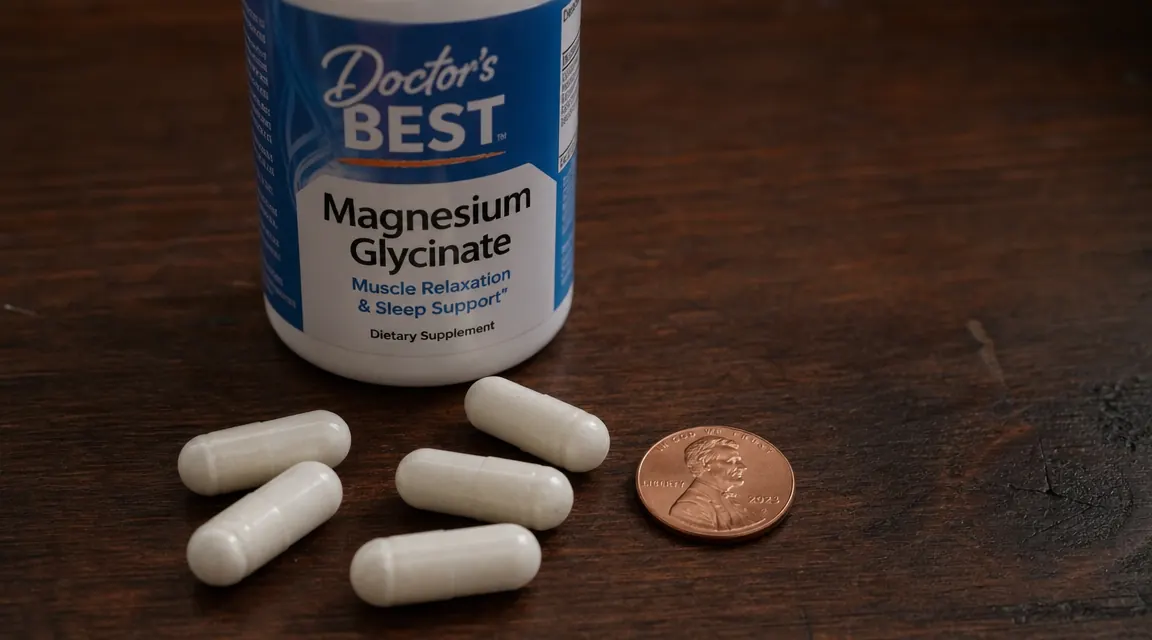
I am not a small man. I have swallowed horse pills my whole life without a second thought. The Doctor's Best magnesium glycinate capsules still gave me pause the first time I shook two into my hand. These are long, white, oval capsules, not tiny softgels. Each one is roughly the length of a thumbnail. The serving size is two capsules for 200mg of elemental magnesium. The label suggests 100mg to 400mg daily, meaning you could be swallowing up to four of these at once.
Most people figure out within a day or two that taking them with a full glass of water and a small bite of food makes this easier. But I have seen reviews from folks who bought the bottle and then could not comfortably take the dose because they struggle with large capsules. No review I read before buying mentioned this. The company does not make a powder or a smaller-capsule version in this exact formula, so if you have trouble swallowing large supplements, know what you are getting into.
Why Glycinate and Not the Cheap Stuff
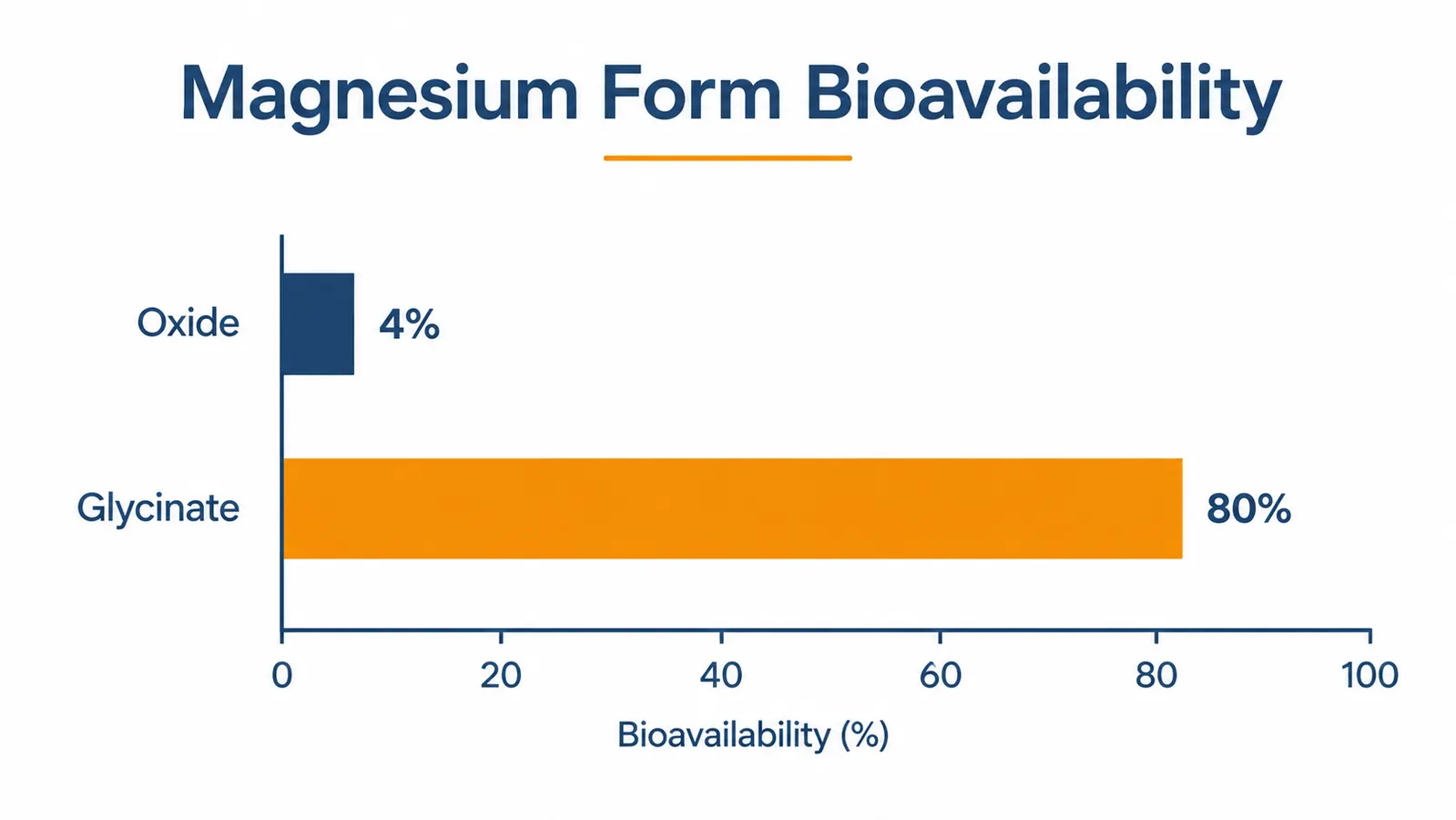
The magnesium at the truck stop was magnesium oxide. It costs about four dollars for a hundred tablets and does almost nothing useful for sleep. Oxide form is roughly four percent bioavailable, which means your body absorbs maybe four cents of every dollar of magnesium you actually paid for. The rest heads straight to your colon, which is actually the entire reason magnesium oxide is marketed as a laxative.
Glycinate is a different animal. The magnesium is chelated, meaning it is bonded to glycine, an amino acid. That bond survives the stomach and survives the gut barrier, delivering a dramatically higher percentage of magnesium directly into the bloodstream. Research estimates bioavailability in the range of 80 percent for chelated forms versus that four percent for oxide. That is why you can take a smaller dose and feel an effect you would never get from a handful of cheap tablets.
Doctor's Best uses TRAACS-certified magnesium glycinate lysinate chelate, which is an albion-minerals branded ingredient. That matters because the chelation process is not standardized across manufacturers. A bottle that just says 'magnesium glycinate' on a generic label may use a weaker chelation that performs closer to oxide than to a true glycinate. The TRAACS certification is one of the few third-party signals that the chelation was done correctly.
What Nobody Tells You About the First Three Weeks
Here is the thing that almost cost me a return. I took two capsules (200mg) my first night in that Albuquerque motel room and waited to feel relaxed. I felt nothing. I slept about the same as usual, which was not great. Night two, same. Night three, same. I thought the dispatcher had sent me down a rabbit hole of supplement hype.
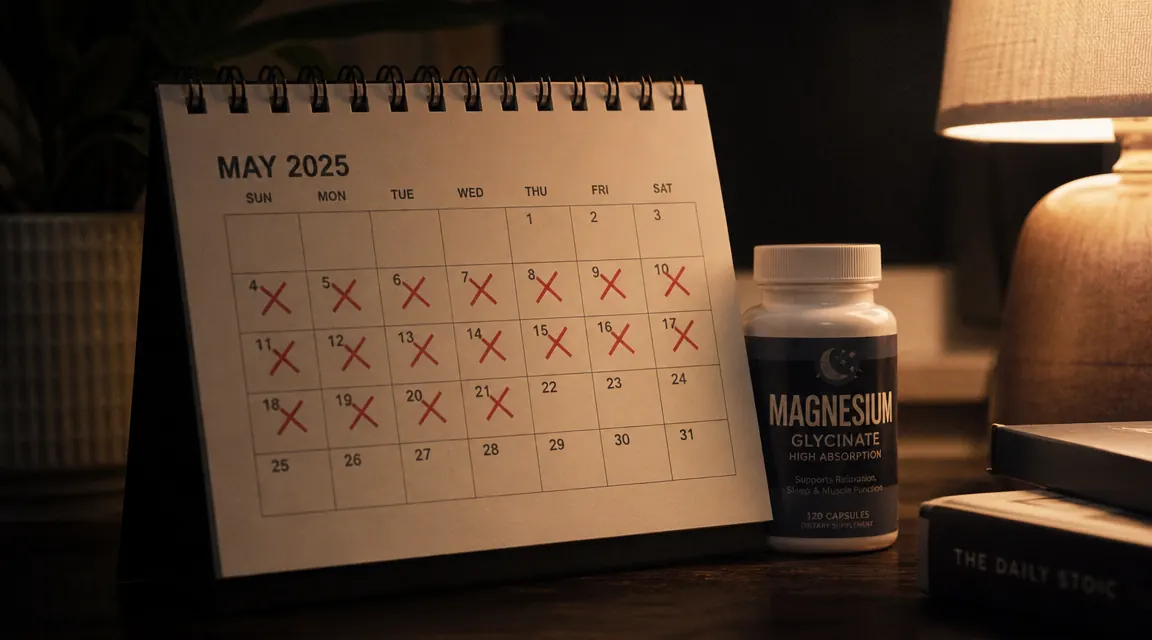
What I did not understand is that magnesium glycinate is not a sedative. It is not melatonin. It does not make you feel drowsy or woozy thirty minutes after you take it. What it does is gradually correct a magnesium deficiency in your tissues, and that correction takes time. Research and user data generally suggest that most adults who respond to magnesium glycinate start noticing consistent improvement somewhere between week two and week four. Not night one. The people who try it for five days, feel nothing, and write a one-star review are almost always stopping before the compound effect has a chance to build up.
Magnesium glycinate is not a sleeping pill. It is a deficiency correction. If you treat it like melatonin and expect to feel it in thirty minutes, you will quit before it ever has a chance to work.
By week three I noticed I was waking up fewer times per night. By week four the 3am eyes-wide-open problem that had been chasing me for years had softened. I was not sleeping like a teenager, but the quality shifted in a way I could actually feel in the cab during afternoon drives. Fewer stretches where I was fighting my eyelids on a straightaway. That matters a lot when you are behind the wheel of an eighty-thousand-pound vehicle.
The Dose Problem Nobody Warns You About
The label says 100mg to 400mg per day. I started at 200mg (two capsules). After about three weeks I read somewhere online that some people do better at 400mg. I bumped up to four capsules one evening. By morning I understood why dose discipline matters with this supplement.
Higher doses of magnesium, even in glycinate form, can cause loose stools. Not everyone. Not every time. But the mechanism is real: your gut has a saturation point for how much magnesium it can absorb at once. What cannot get absorbed draws water into the intestine instead. It is not dangerous, but it is uncomfortable, and it will definitely wake you up, which is the opposite of why you are taking a sleep supplement at night.
I went back to 200mg. Over the following two weeks I tried 300mg and found that to be my personal ceiling where the benefit was maximized and the gut impact was zero. But that number is different for everyone. The smarter approach is to start at 100mg for a week, go to 200mg, wait a week, and only move up if you genuinely feel like more is needed. The people who blow past 400mg in the first few days and then complain the supplement did not work often did not give their gut time to adjust. They just had a bad experience and stopped.

Who Is Actually Deficient in Magnesium
Before I started taking this I assumed magnesium deficiency was a rare thing. It is not. Conservative estimates suggest around 45 to 50 percent of American adults do not meet the daily recommended intake of magnesium through diet alone. The reasons are not surprising: soil depletion over decades has reduced the magnesium content in vegetables compared to what a garden produced in 1950. Processed food is almost completely stripped of it. And there are specific categories of people who run even lower than average: heavy coffee or alcohol drinkers, people on proton pump inhibitors or diuretics, anyone with type 2 diabetes or pre-diabetes, and people who sweat heavily doing physical labor. Truckers who live on diner food and coffee for weeks at a stretch are not exactly magnesium-rich.
The catch is that standard blood tests do not reliably detect magnesium deficiency. Most of your body's magnesium lives in bone and soft tissue, not in serum. A blood panel can come back normal while your tissues are running low. This is why some doctors do not catch it and why self-supplementing at reasonable doses is generally considered safe for otherwise healthy adults. That said, if you are on any prescription medication, run it past your doctor first, because magnesium interacts with certain antibiotics and blood pressure drugs.
What Actually Improved for Me, and What Did Not
I want to be straight with you because that is the whole point of this review. Here is what got better: falling asleep is faster, maybe by fifteen to twenty minutes on most nights. The middle-of-the-night wake-ups dropped from three or four times to usually one, sometimes zero. Morning grogginess is noticeably lighter. My legs stopped doing that restless crawling sensation around midnight, which had been wrecking my first sleep cycle for years. That symptom alone made this worth every cent.
Here is what did not change: I still sleep lighter in a noisy motel than I do at home. A slamming ice machine at 2am is still a slamming ice machine. Magnesium glycinate is not a sedative and it does not produce deep anesthesia-like sleep. If your insomnia is driven primarily by noise, light, anxiety, or sleep apnea, this supplement addresses none of those root causes. It addresses the physiological piece, which is one piece of a larger puzzle. Think of it as clearing the floor of one obstacle, not solving everything.
Value and the Competition
At around $21 for 240 capsules and a recommended dose of two to four capsules per day, you are looking at sixty to one hundred twenty days of supply per bottle. That comes out to roughly seventeen to thirty-five cents per day. Compared to other chelated magnesium glycinate supplements, Doctor's Best is on the lower end of the price range without cutting corners on the chelation certification. The Pure Encapsulations version, which I looked at hard before committing to Doctor's Best, runs roughly four times the price for a similar chelated formula. I compared the labels side by side and could not find a meaningful difference in the elemental magnesium content or the chelation type that would justify that premium for most people. I cover that comparison in detail in a separate piece if you want the full breakdown.
The bottle design is basic and utilitarian, which I appreciate. No fancy packaging eating into your cost. The label is clear and honest about the form of magnesium used, which is more than most supplement brands manage. The capsules do have a very faint chalky smell when you first open the bottle. It goes away quickly and does not transfer to taste, but it surprised me the first time.
What I Liked
- TRAACS-certified chelation, one of the most bioavailable magnesium forms available
- Noticeably better sleep onset and fewer middle-of-night wake-ups after three to four weeks of consistent use
- One of the lowest cost-per-serving options in the chelated magnesium category
- Restless leg symptoms reduced significantly at 200 to 300mg nightly
- No proprietary blend hiding, label is transparent about every ingredient
Where It Falls Short
- Large capsule size is a real issue for anyone who struggles swallowing pills
- Three-week lag before most people feel anything, many quit too early
- Doses above 350 to 400mg frequently cause loose stools, requires personal calibration
- Not a sedative, will not work for insomnia driven by noise, light, or anxiety
- Faint chalky odor when bottle is first opened
Who Should Buy This
If you are an adult over 35 whose diet runs heavy on processed food and light on leafy greens and you have been sleeping poorly without a clear cause, this supplement is a reasonable starting point. If your insomnia comes with restless legs, nighttime muscle cramps, or the feeling that your nervous system never quite powers down at the end of the day, glycinate is specifically well-matched to those symptoms. If you can commit to four weeks without judging results after four days, you have a reasonable shot at real improvement. The price is low enough that you are not gambling much.
Who Should Skip It
If you have kidney disease, take diuretics, or are on any medication that affects your potassium or magnesium balance, talk to a doctor before touching any magnesium supplement. If your insomnia is rooted in sleep apnea, a supplement will not fix an airway obstruction. If you cannot swallow large capsules comfortably, look for a magnesium glycinate powder format from another brand before committing to this one. And if you need a knockout pill that hits in thirty minutes, this is not that product and it never will be.
Four weeks of commitment for a modest investment. That is a fair trade if you have been waking up exhausted for months.
Doctor's Best High Absorption Magnesium Glycinate Lysinate. 240 capsules. TRAACS-certified chelation. Check what it is running today before you decide.
Amazon Check Today's Price on Amazon →